Thursday, 4 January 2018

Sangam House-International Writers' Residency, Nrityagram, Bangalore


Having just returned from a four week stay at Sangam House International Writers’ Residency, I can well say that Sangam House is a writer’s paradise. Initiated by a group of acclaimed writers, Sangam House is hosted within the beautiful premises of Nrityagram, the dance school founded by Late Protima Gauri Bedi near Bangalore. The sprawling campus of Nrityagram where the Sangam House Writers’ Residency is hosted has been designed by the well known architect Gerard da Cunha. The local material, exposed stone and brick structures, mud tiles, in-situ flooring, thatched roof, simple but attractive architectural designs that seamlessly merge with the beautiful landscape of Nrityagram add to the aura of the writers’ residency. Stone and mud sculptures as well as striking photographs of dancers in sensual thribhangi (three bends of the body) Odissi postures by renowned artists adorn the Nrityagram campus. The architecture and the art at Nrityagram further inspire writers to be their creative best.


Nrityagarm. Photo: Shripad Dharmadhikary.


Nrityagram. Photo: Shripad Dharmadhikary.

 
Exposed stone and mud structures at Nrityagram. Photo: Nandini Oza


Among the many beautiful structures of Nrityagram, the residential complex for the writers’ named Kula which means home, is also brilliantly designed and constructed with local material. It is at the Kula that eighteen to twenty writers from across the world are offered a maximum of four week residency every year. The Sangam House receives over hundred applications from writers around the globe. At a time, there are up to eight resident writers at the Kula between the months of November and February every year. The Sangam House residency has hosted around hundred and fifty writers from across the world since its inception a decade ago.http://www.sangamhouse.org/


Kula, Sangam House Writers' Residence. Photo: Nandini Oza


Rooms for writers at Kula. Photo: Nandini Oza

The individual rooms offered to the writers at Kula have all the modern facilities although the design is traditional. The writers’ have the entire day to themselves to write without a care of the daily humdrum. There is a well stocked kitchenette with generous supply of food and drinks within the Kula that the writers can avail of any time of the day. Besides, delicious and very healthy meals are provided by the Nrityagram kitchen in the dining area shared with the acclaimed Odissi dancers of the dance school. Lunch with the lively and beautiful dancers in their colorful attire is an added delight where writers get an opportunity to interact with the dancers closely.  


The common area at Kula. Photo: Nandini Oza


 The path from the Kula to the Nrityagram common dining area itself is a dream walk with diverse species of plants and trees with wonderful bird life. On the way one passes the dancing areas of the school where dancers with fit and flexible bodies practice tough Odissi dance steps and postures. The disciplined regime and fitness of the dancers too inspire the writers to follow suit. The Gurukul Parampara practiced at Nrityagram is a very humbling experience. The writers’ are free to watch the dance practice at the Nrityagram dance school during the day or in the evenings at the amphitheatre.  The amphitheatre is an attractive structure made of stone and red mud where Nrityagram hosts its annual dance program called Vasantsabbha which some of the lucky writers get to see. While there are writers' residencies across the World, the confluence of dancers and writers at Sangam House is unique and special.


Add caption

Along with the lovely campus, there are other features of the Sangam House residency that are specially designed for writers and cater to their needs. A carefree writing time for a month amidst pristine nature away from the maddening crowds is rare and an absolute delight. Often birds such as the hoopoe, bulbul, woodpeckers, partridges, sun-birds, etc can be seen while the writer is at the writing desk overlooking a window. The windows open to wide expanses of green fields and trees. Writing is essentially an individual exercise, many times quite isolating and lonely. Sangam House carefully offers the required isolation and space that a writer requires during the day. At the same time it offers an excellent opportunity to writers to mingle with other resident writers from across the world in the evenings.

Four week of stay with seven other writers at Sangam House is not only an enlightening experience but it is also an opportunity to develop lasting friendships. Writers at Sangam House leave behind their published books which are stocked in a library across the Kula with free access. While writers read and write through the day, long walks through the famous grasslands of Hesaraghatta where Nrityagram is located are popular. And then at sharp seven in the evening, winding up the day's work, one and all come together to sing, eat, dance, share writings and lives over drinks and food. Delicious dinner is sent across to Kula by Nrityagram kitchen and to it, some additional dish is added by a cooking enthusiast writer. Once a week, the writers cook together, mostly the cuisines of the region they belong to. With sumptuous and diverse food, yogasan at the Nrityagram yoga centre built out of stone and thatched roof becomes a must.

Hesaraghatta grassland. Photo: Shripad Dharmadhikary.

The regular readings at Sangam House open up diverse writings in different languages before the resident writers. The readings are special as the writers capture the right essence of the prose or poetry they have themselves created. That there are carefully selected established and upcoming writers at Sangam House, makes it possible to learn about the experiences, opportunities, struggles and challenges faced by the writers in different corners of the world.  The talks over dinner meander from writings to publishers, from royalty to translations, from agents to editors and so on. Therefore there never is a dull moment when writers come together in the common area of the Kula every evening. Sometimes, taking inspiration from the writers, dancers too join and share their writings which are varied in content and substance. This is also the time when the writers have an opportunity to offer something to the dancers in return for all the things learned from them. 

 As the creative evening spills over into the night, the writers have the company of the Kula’s three loving dogs, Kapita, Guru and Chiku. And then, when the hoot of the owls and stridulating of the crickets and the croaking of the frogs and the chirping of the geckos get louder, it is time for all to retire to the rooms for a fresh start the next day.

 When life is a struggle for most writers’ in the real world no matter which part of the globe, Sangam House Writers’ Residency is an oasis for both established and upcoming writers. It could only have been brilliant minds that conceptualized Sangam House and more importantly compassionate hearts that have turned Sangam House into Sangam Home for its writers.  

End


Monday, 11 September 2017

Ex-Chief Minsiter of Gujarat (BJP) Questions PM Mr. Modi on Sardar Sarovar Dam


Ex-Chief Minister of Gujarat (BJP) Mr. Suresh Mehta Questions PM Narendra Modi on the eve of PM’s plan to inaugurate the Narmada Project (Sardar Sarovar Project)

A very important development is unfolding within Gujarat as PM Mr. Narendra Modi plans to inaugurate the Sardar Sarovar Dam Project (SSP) with a lot of fanfare in Gujarat on his birthday, 17th September 2017. 


Mr Suresh Mehta, the former Chief Minister of Gujarat from the Bhartiya Janta Party (BJP) and belonging to the drought prone region of Gujarat, has issued the following leaflet in Gujarati today the 11th of September 2017, scathingly attacking the false claims by the Government of Gujarat regarding the Narmada Dam (SSP) Project. 

Important excerpts from the leaflet which is being widely circulated in Gujarati on social media (today) is translated here (by me) for a wider readership. This is a quick and rough translation.  The authenticity of the leaflet has been confirmed by a senior journalist in Gujarat.


Sardar Sarovar Narmada Dam Project, Gujarat. Photo Source: Not Known
:


Translation:

“Press Release                                                              11-September-17

                                                Narmada Project
                   Gujarat Government Cheating Six Crore Gujaraties 


It has been said that the Narmada Project (SSP) is the life line of Gujarat. But during the last fifteen years or more, the Gujarat Government has not been able to complete the work of the Narmada Project and has not been able to reach the waters to the farmers and this is the best example of its raw/uncouth/untrained  administration. 

                Can this be called Development? Can this be called good Governance? 


Only one tenth of the irrigation achieved:

    1.      It was planned that 17, 92,000 hectares would be irrigated by the Narmada project in Gujarat...in 2012-13, the area under irrigation increased to 2, 09,057 hectares... Between 2012-14 the area under irrigation did not increase at all...a year later also, that is in the year 2014-15, there has been no increase in the area under irrigation at all. This way, out of the area to be irrigated by the Narmada project, only 11.67 % is being irrigated and this is what the Government itself is saying. 


   2.      The Government of Gujarat’s target itself for irrigation now is very small...the Government is saying that during the years 2017-18 and 2018-19 the increase in irrigation will be to 3, 30,160 hectares...Thus at the end of 2018-19, the irrigation by the Narmada Project will be 18.42%. The meaning of this is that no attention has been paid at all to increase irrigation through the Narmada Project. On the other hand the Government continues to spend crores of rupees on the Narmada Project. 


Out of 90 thousand 42 thousand Kilometers of Canal work remains to be completed:


   1.      The area under irrigation has not increased because of the reason that the work of building of the canal is not going on as fast as it should...As per the original documents and planning, the total length of the Narmada canals was 90, 389 kilometers... As per a reply given in the Legislative Assembly by the Government, the State Government reduced the length of the canal to 85,898 kilometers. Once again a reduction has been made to 71,748 ...In this way, the Government of Gujarat has reduced the length of the canal by more than 18,000 kilometers...If the length of the canal is reduced, less area will be irrigated. 

   2.      In spite of having decided to build fewer canals, the Government of Gujarat has not been able to build even those fewer canals in the last fifteen years... 41,318 kilometers of canals have not been built at all.

   3.      ...The Government itself is admitting that the work of the canal has not been completed. The Government is also saying that in the year 2017-18, it will build 3,856 kilometers of canal only...If this is the pace at which the Government of Gujarat is going to work, in order to complete all the canals it will take nearly eleven more years!! Right now the Government of Gujarat is spending (on the project) 9000 crores a year. At this rate in the coming eleven years the budget will reach 99,000 crores!! Experts say that by the time the dam height increased, it was possible to do the work of the canals. But the Government failed to do so. Considering this, is not the Government of Gujarat guilty?

   4.      ...That the work of the Narmada canal has not been completed is of course a big crime by the Government of Gujarat, but out of the canals that are built, most of these are completely of poor quality construction and there are breach/holes at several places and the canals have not even been repaired at many places. This expenditure is also being borne by the six crores of Gujaraties.  


    5.      ...The proof of how poor the quality of the canal work by the Government has been is clear because the recent floods in Banaskatha were the result of the breaches in the canals...


Huge increase in expenditure and insignificant result:


   1.      As per the initial planning, the total expenditure of the Narmada Project was approximately Rs 6,000 crores. But this has escalated to 56,268 crores by October 2016... The question is that the canal is not fully completed and there has been a huge delay. Then why so much of increase in cost? The meaning of this is that the Government of Gujarat is criminally neglecting the Narmada Project.  


As per independent auditor report there is misappropriation in abundance in Narmada Nigam


In the annual report of Sardar Sarovar Narmada Nigam Limited of the year 2015-16, the report of independent auditor Ghiya and Company has been quoted. That (report) shows that there is a lot of misappropriation in the accounts of the Nigam. In most of the cases they say that standards of accounting have not been maintained. As per what has been said on page number 41 of the report...it is possible to conclude that Sardar Sarovar Narmada Nigam is working Ram Bharose!! The independent auditor report says that in the matters of the water charges to be collected by the Nigam, Land records, Property, Debt, Capital, Interest, Brokerage, Maintenance, etc. the internal regulation of the Nigam is not working effectively at all!! Then in what matter is the Nigam working properly? When the account of crores of rupees is not available at all can it be called Good Governance?


Sureshchandra Mehta, Ex Chief Minister Gujarat  [and]  Prof. Hemantkumar Shah
------------------------------------------------------------------------------------
Sureshchandra Mehta-Ex-Chief Minister Shree. 6-7, Rangoli Complex, Opposite V.A. Hospital, Ahmedabad-380006”


End

Monday, 22 May 2017

Ah! Mumbai


It is difficult to see beyond the harsh reality of Mumbai and its stark disparity and the ruthless power centers. The Mumbai slums and footpath dwellers particularly in the backdrop of the rather grotesque Antila and the daunting Taj Mahal Palace Hotel makes one sad and angry at the same time.

And yet, this time, during my visit to Mumbai I simply decided to wander about and click whatever drew my attention.

I share some photos of the mega-city as I saw it this time around.

Close to Regal Cinema.

View from YWCA, Madam Cama Road.

  I would recommend that women travelling by themselves stay at Young Women's Christian Association (YWCA) guest house which is housed in a heritage building. Centrally located, YWCA is within five minutes walk from Gateway of India. YWCA with its distinct features is very different from a hotel. One can also meet fellow travelers from all over the world here particularly at dinner time. The charges too are reasonable considering how beautifully located the place is. All of this makes YWCA interesting.


Heritage building of YWCA


Just at a stones throw from YWCA is located the Sahakari Bhandar Restaurat. Even today, sumptuous dosas, idlis and variety of other dishes at very reasonable prices, with its down to earth ambiance is very attractive. 

Closed cotton textile mill at Mahalakshmi


 It was rather sad to see that the lands and buildings of cotton textile mills in Mahalaxmi have now been converted into posh clubs,  high end art gallerias, plush restaurants, discotheques, so on. I recall the time when thousands of retrenched workers of the cotton  mills lay claim to these lands where they once toiled day and night. I wonder if their claims have been met even in part. 

The new and the old


Many such old buildings still remain and have not fallen to redevelopment yet.


Aye Dil Hey Mushkil Jina Yaha, Zara Hatke, Zara Bachke, Yeh Hei Bombay Meri Jaan...


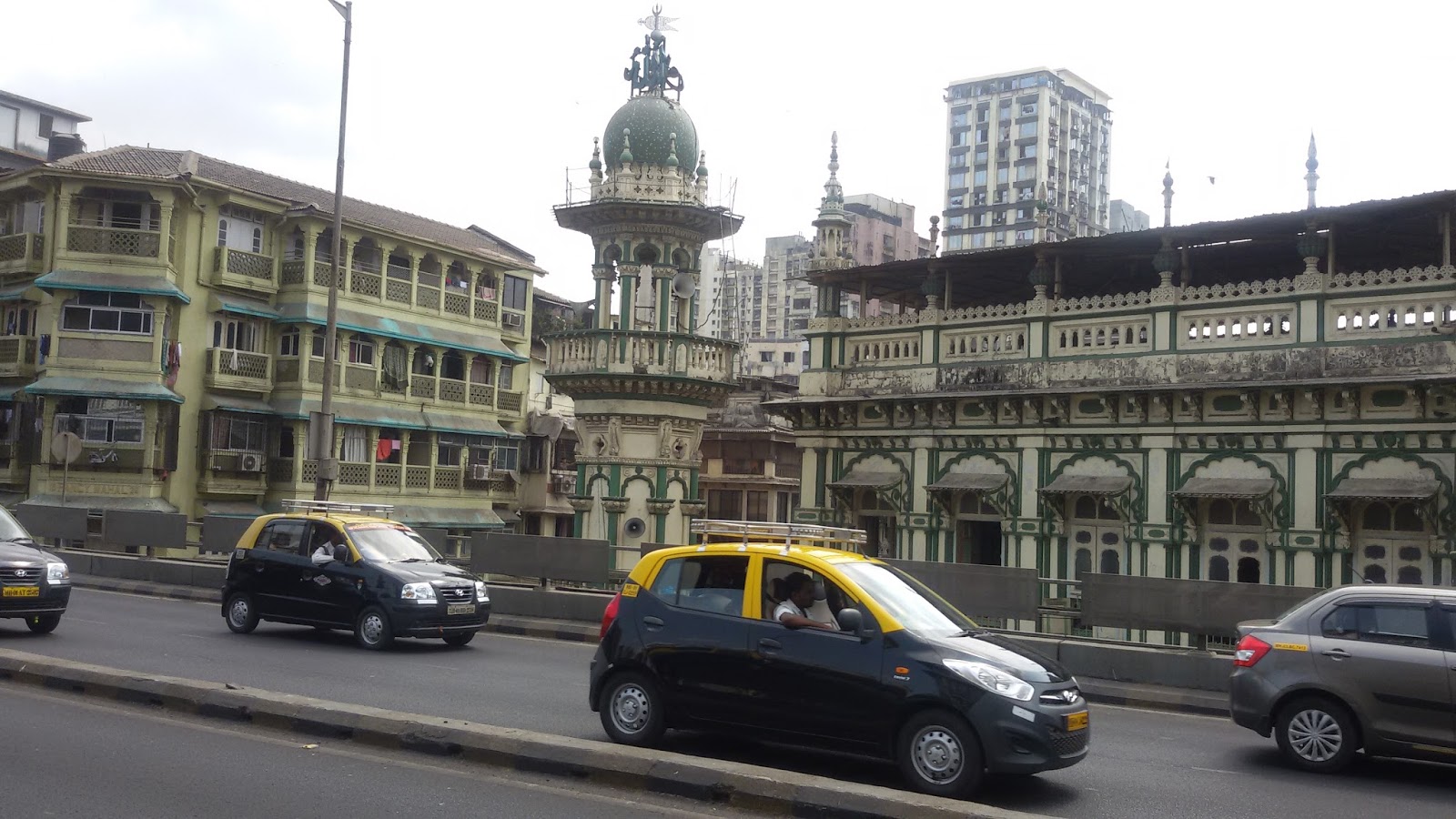
Some of the many mosques


Bhindi Bazar it is said is slated for redevelopment too.I hope at least some of the original character will be preserved. 

Bhindi Bazar at night.

Evening market at Bhindi Bazar.


Olympiad restaurant near Regal cinema.

For non vegetarians as well as for vegetarians, I would recommend food at simple restaurants, Irani joints where the food is not only reasonably priced but delicious too. Importantly, it is fresh,  served with fresh pudina / mint leaves or pudina chatni. I enjoyed the distinct-Indian ambiance too. 

 Attar shop near Regal Cinema


Forget Ola and Uber, to travel around Mumbai, kali-pili taxi is the way to go. The taxi drivers, grounded in the local customs, traditions and history, double up as excellent guides. I would not have discovered the many sights, sounds and tastes of Mumbai but for the kali-pili taxi drivers. 

 Enjoying cold lassi at the gates of Aarey Milk Dairy opposite Worli Sea Face with a very well informed and proud taxi driver.


Worli Sea Face opposite Aarey Milk Dairy.


Mumbai it seems is all about land these days. There is a talk about taking over the lands of Aarey milk dairy for redevelopment too. But for me, Mumbai is all about the sea.

Sea opposite the Taj Hotel.

Even during the sweltering month of May, a walk by the sea side is refreshing. 

Hope to see you soon, Mumbai!

end.